
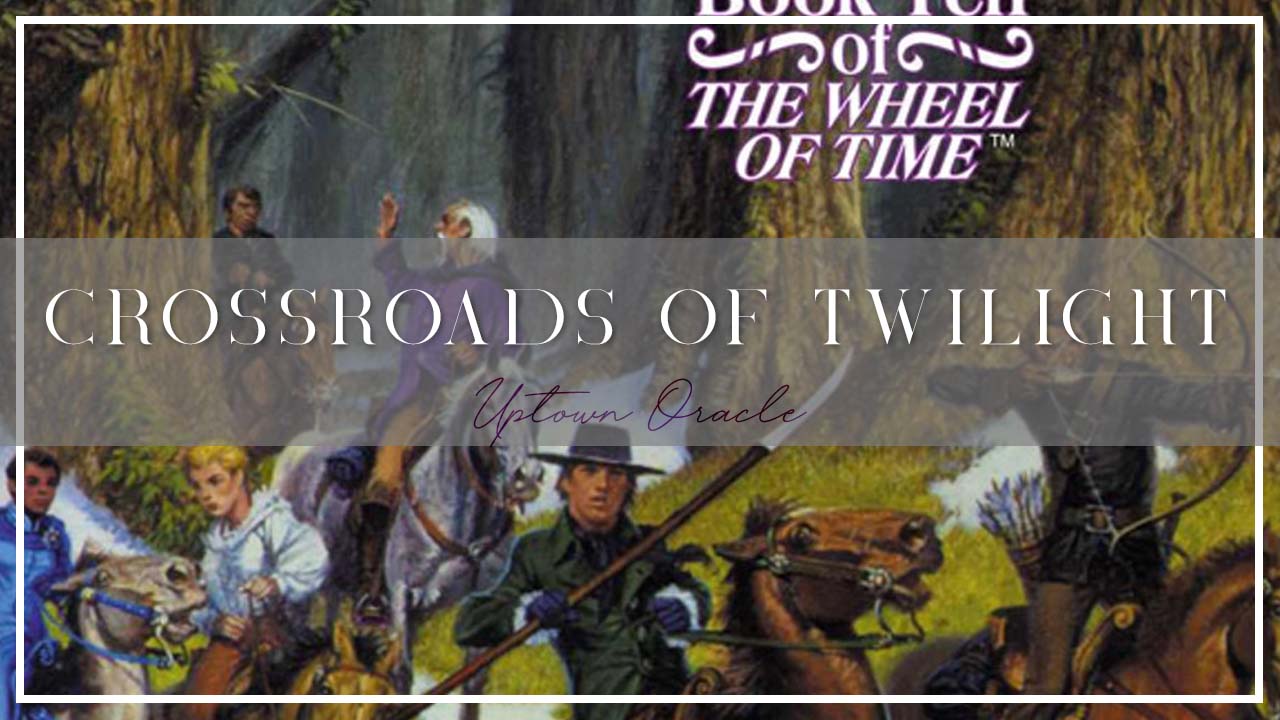
Crossroads of Twilight, the tenth instalment in Robert Jordan’s Wheel of Time series, is infamous among fans for its glacial pace and lack of major plot advancement… and I’m not surprised after reading it.
However, while it may be light on action, the novel excels in political intrigue, deepening worldbuilding, and exploring how the shadow of the Dragon Reborn affects those left to carry on in his absence. For long-time fans, it’s an exercise in patience but one with a few key character developments and thematic threads worth noting.


(Affiliate Links)
Fleeing from Ebou Dar with the kidnapped Daughter of the Nine Moons, whom he is fated to marry, Mat Cauthon learns that he can neither keep her nor let her go, not in safety for either of them, for both the Shadow and the might of the Seanchan Empire are in deadly pursuit.
Perrin Aybara seeks to free his wife, Faile, a captive of the Shaido, but his only hope may be an alliance with the enemy. Can he remain true to his friend Rand and to himself? For his love of Faile, Perrin is willing to sell his soul.
At Tar Valon, Egwene al’Vere, the young Amyrlin of the rebel Aes Sedai, lays siege to the heart of Aes Sedai power, but she must win quickly, with as little bloodshed as possible, for unless the Aes Sedai are reunited, only the male Asha’man will remain to defend the world against the Dark One, and nothing can hold the Asha’man themselves back from total power except the Aes Sedai and a unified White Tower.
In Andor, Elayne Trakland fights for the Lion Throne that is hers by right, but enemies and Darkfriends surround her, plotting her destruction. If she fails, Andor may fall to the Shadow, and the Dragon Reborn with it.
Rand al’Thor, the Dragon Reborn himself, has cleansed the Dark One’s taint from the male half of the True Source, and everything has changed. Yet nothing has, for only men who can channel believe that saidin is clean again, and a man who can channel is still hated and feared-even one prophesied to save the world. Now, Rand must gamble again, with himself at stake, and he cannot be sure which of his allies are really enemies.
Elayne’s arc stands out, frustratingly so. Her pregnancy becomes a central aspect of her storyline, not because of its emotional resonance, but due to how it alters others’ perceptions of her. As a powerful channeler and a political figure in her own right, it’s maddening to see her treated as fragile or incapable. That said, her navigation of courtly politics and her continued campaign for the throne of Andor provides depth, even if it’s more diplomatic than dramatic. Her keeping the father of her children a secret is a subtle but well-done element, although letting people assume her relationship with her bodyguard (a deeply suspicious figure) is curious at best.
Perrin, another usually beloved character, is largely wasted here. His search for Faile, who remains a prisoner, is drawn out to the point of frustration. Instead of significant action or clever strategising, we get long passages of travel, scent-based emotional analysis, and internal angst. It’s a missed opportunity, especially given how compelling Perrin’s storyline has been in previous books.
Rand’s near-complete absence leaves a noticeable void. While this gives space for the supporting cast to grow, it also makes the book feel meandering.
The novel’s structure mirrors its pacing: slow, methodical, and often static. Most of the chapters feel like snapshots rather than progressions. Threads are picked up and put down without real momentum.
That said, the quiet tension beneath many interactions helps build anticipation for future conflict. Political movements, diplomatic manoeuvres, and societal shifts take precedence over swordplay and channeling.
Highlights include the rippling effects of the Seanchan’s invasion, the preparations being made in their wake, and the growing divide between those who still wait on the Dragon Reborn and those choosing to act independently.
Jordan continues to excel in layering his world. We see the ripple effects of the Seanchan occupation across multiple cultures and groups. The Sea Folk, the rebel Aes Sedai, the rulers of Andor—all are dealing with a changed reality, often without the central figure they’ve come to rely on: Rand.
This book is deeply political. Nearly every POV character is engaged in some form of negotiation, alliance-building, or subterfuge. While the lack of action makes this feel like filler to some, it also underlines the sheer scale of Jordan’s creation.
Magic is present but subdued. One of the more fascinating developments is how pregnancy affects a woman’s ability to safely channel, hinting at deeper rules in Jordan’s magical system. Though the One Power takes a backseat here, it looms in the background, particularly in scenes involving Aes Sedai factions and the threat of the Seanchan’s damane.
Themes of autonomy, patience, and the cost of war echo throughout. The absence of Rand is a narrative choice that symbolises a larger idea: that the world must continue, even without its prophesied hero. Characters are forced to lead, to compromise, and to survive on their own terms.
Elayne’s fight for political legitimacy while balancing her personal life reflects the push and pull between identity and responsibility. Perrin’s storyline, though frustratingly slow, continues to explore the idea of duty versus emotional restraint that mirrors Rand’s own.
Jordan’s prose remains consistent: descriptive, deliberate, and immersive. For some readers, this depth is a delight. For others, especially in a book light on major developments, it’s a slog.
There are moments of levity and strong dialogue, but much of the book feels like groundwork, necessary, perhaps, but not particularly exciting.
As part of a larger whole, Crossroads of Twilight is a transitional volume. It bridges major storylines and prepares the stage for the final act, but rarely commands attention on its own. It’s a book best appreciated by series veterans, not newcomers or casual readers.
Positives of Crossroads of Twilight
- Expansive worldbuilding and cultural detail
- Elayne’s political arc and secret-keeping
- Seanchan aftermath and societal shifts
Negatives of Crossroads of Twilight
- Glacial pacing and little action
- Perrin’s arc feels stagnant
- Rand’s absence leaves the book feeling aimless
Crossroads of Twilight may test your patience, but it also quietly reinforces the scope and depth of The Wheel of Time. While it may not shine in action or plot advancement, it’s a contemplative instalment that shows what happens when the world continues turning, even in the Dragon’s absence.
If you enjoy politics, power plays, and intricate worldbuilding, you’ll find value here. If you came for battles and explosive twists, you might want to skip ahead.
If you enjoy content on Uptown Oracle consider supporting us:
Ko-fi | PayPal
Crossroads of Twilight by Robert Jordan 👀 A Breath Before the Storm… | Uptown Oracle

Crossroads of Twilight, the tenth instalment in Robert Jordan’s Wheel of Time series, is infamous among fans for its glacial pace and lack of major plot advancement… and I’m not surprised after reading it.
URL: https://amzn.to/4myeRQs
Author: Robert Jordan
3
