
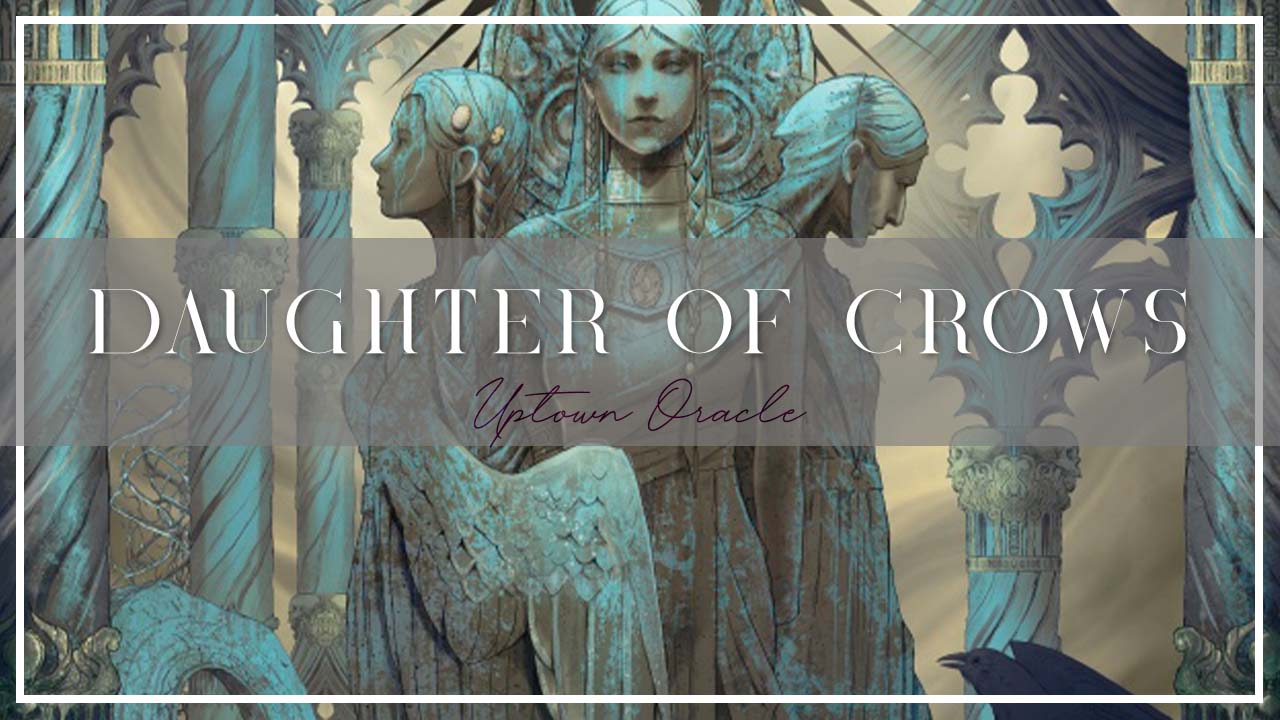
Mark Lawrence has never been afraid to explore the darker corners of fantasy, and Daughter of Crows is no exception. Blending brutal institutions, fractured timelines, and mythological inspiration, this is a story that demands patience but rewards it with layered reveals and emotional depth.
At its core, the plot is about a life unravelled and rebuilt, a character study wrapped in mystery, magic, and vengeance.


(Affiliate Links)
Set a thief to catch a thief. Set a monster to punish monsters.
The Academy of Kindness exists to create agents of retribution, cast in the image of the Furies—known as the kindly ones—against whom even the gods hesitate to stand. Each year a hundred girls are sold to the Academy. Ten years later only three will emerge.
The Academy’s halls run with blood. The few that survive its decade-long nightmare have been forged on the sands of the Wound Garden. They have learned ancient secrets amid the necrotic fumes of the Bone Garden. They leave its gates as avatars of vengeance, bound to uphold the oldest of laws.
Only the most desperate would sell their child to the Kindnesses. But Rue … she sold herself. And now, a lifetime later, a long and bloody lifetime later, just as she has discovered peace, war has been brought to an old woman’s doorstep.
That was a mistake.
Molly also known as Rue is the centre of everything, and this is very much her story. From the moment she sells herself into the Academy of Kindness, there’s a sense that she is different from the others, driven by something deeper, darker, and more desperate.
What makes her compelling is that we don’t fully understand her at first. Through shifting timelines, we see fragments of who she is, who she was, and who she becomes. It’s only as the story unfolds that those pieces begin to align, revealing a character shaped by survival, loss, and something far more dangerous beneath the surface.
Bek and Einsa are two of the earliest connections Molly forms, and their dynamic brings much-needed emotional grounding to the story. Their push-and-pull relationships, pulling each other out of isolation, challenging one another, and forming fragile bonds, feel authentic within such a harsh environment. They’re not just side characters; they’re catalysts for Molly’s growth.
The premise is immediately striking: the Academy of Kindness, where daughters are sold, and only three will graduate. It’s a brutal system, one that forces girls to form factions and alliances quickly. Survival here depends as much on social manoeuvring as skill.
Molly’s presence disrupts that system somewhat. She hasn’t been sold by others she chose this path herself, escaping something even worse. That choice alone sets her apart, and the story gradually reveals why.
Running alongside this is the chilling concept of the Cruelties, a faction that trains children to endure fear and survive it. Through the perspective of “Eldest,” we uncover layers of the world’s magic system and the structures underpinning it. These sections deepen the lore in a way that feels both unsettling and fascinating.
The narrative itself is highly twist-driven. Early on, there’s a sense of disorientation where like the characters, we don’t have enough information to fully understand what’s happening. But as the story progresses, the reveals begin to click into place, creating those pause and stare at the page moments. It’s a book that almost demands a re-read, just to catch the breadcrumbs you missed the first time.
Lawrence leans heavily into a multiple timeline structure, weaving past and present together in a way that mirrors Molly’s fragmented identity. As the timelines converge, clarity emerges about the plot, but also the character at its centre.
His prose is, as expected, stunning. Sharp, evocative, and often quietly brutal, it carries the reader through even the most confusing sections. There’s a confidence to the writing that trusts the reader to keep up.
Daughter of Crows explores revenge and the cost of pursuing it, friendship in environments designed to destroy trust, and identity and the truths we uncover about ourselves over time.
There’s also a strong mythological undercurrent. The original title “Maiden, Mother, Hag” alongside clear inspiration from the Morrigan and the Furies, adds a layer of symbolic depth. This is a story about transformation, cycles, and the power of becoming something more than what the world expects.
This sits firmly within dark epic fantasy, with strong elements of grimdark and mythological fantasy. But it’s not a straightforward narrative, being more layered, nonlinear, and often intentionally disorienting.
Daughter of Crows is a dense, twist-filled fantasy with powerful reveals and a deeply compelling central character. While its structure can be confusing early on, the payoff is worth it, leaving you with a story that lingers and invites a second look.
Positives of Daughter of Crows
- Complex, layered protagonist with a compelling arc
- Intriguing world-building and magic system
- Strong mythological inspiration
- Satisfying, twist-heavy narrative
Negatives of Daughter of Crows
- Confusing in the early stages due to limited information
- Multiple timelines may feel disorienting
- Requires patience before the story fully clicks
Daughter of Crows isn’t an easy read. It’s a story that asks you to sit in the uncertainty, trust the process, and let the pieces fall into place. and when they do? It’s brilliant.
I received Daughter of Crows by Mark Lawrence from the publisher. This is an unbiased and honest review
If you enjoy content on Uptown Oracle consider supporting us:
Ko-fi | PayPal
Daughter of Crows by Mark Lawrence 🐦⬛ A Dark, Twisting Tale of Revenge, Power, and Becoming | Uptown Oracle

Mark Lawrence has never been afraid to explore the darker corners of fantasy, and Daughter of Crows is no exception. Blending brutal institutions, fractured timelines, and mythological inspiration, this is a story that demands patience but rewards it with layered reveals and emotional depth.
URL: https://amzn.to/4fwm8PM
Author: Mark Lawrence
