
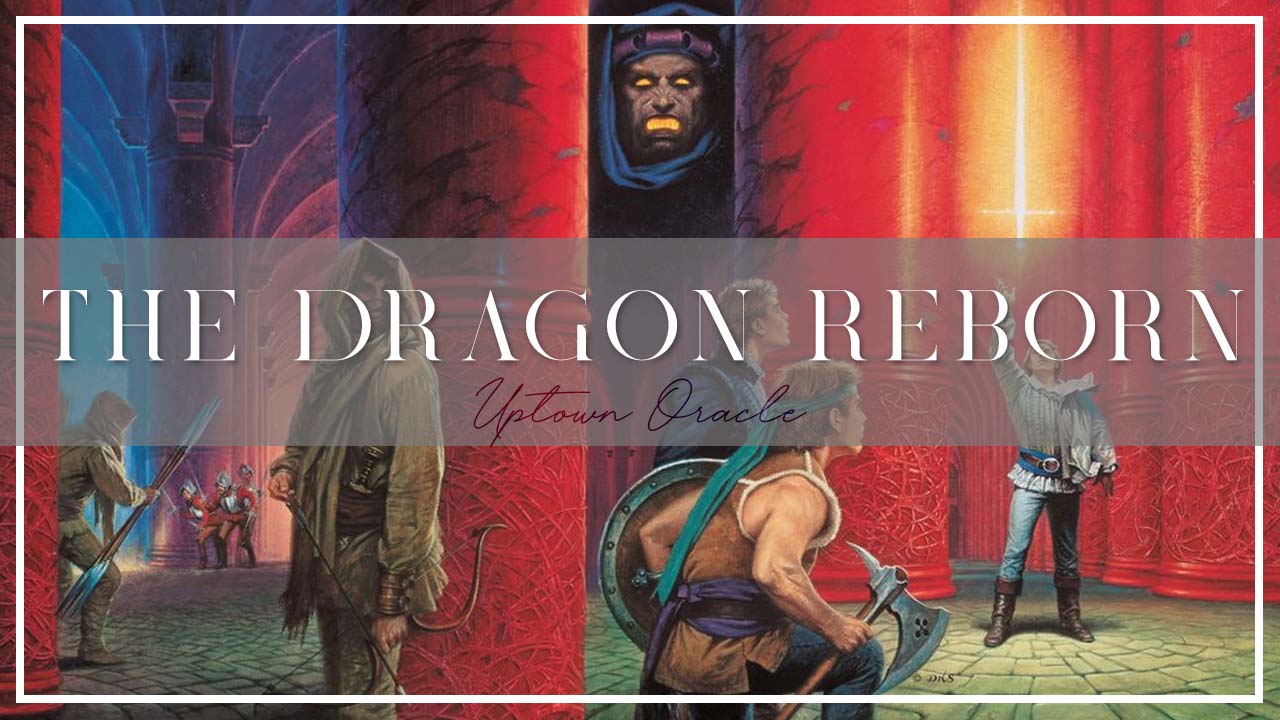
The Dragon Reborn does something bold: it sidelines its supposed main character and proves the series is bigger than any one hero. Rand al’Thor may be the Dragon Reborn, but in this third instalment, he’s more myth than man, glimpsed, feared, and hunted, rather than followed step by step and focus goes to the other characters.
The result is a faster, sharper, more confident book that shakes off any lingering “classic fantasy comfort blanket” energy and leans hard into prophecy, paranoia, and political chaos.


(Affiliate Links)
The Dragon Reborn—the leader long prophesied who will save the world, but in the saving destroy it; the savior who will run mad and kill all those dearest to him—is on the run from his destiny.
Able to touch the One Power, but unable to control it, and with no one to teach him how—for no man has done it in three thousand years—Rand al’Thor knows only that he must face the Dark One. But how?
Winter has stopped the war—almost—yet men are dying, calling out for the Dragon. But where is he?
Perrin Aybara is in pursuit with Moiraine Sedai, her Warder Lan, and Loial the Ogier. Bedeviled by dreams, Perrin is grappling with another deadly problem—how is he to escape the loss of his own humanity?
Egwene, Elayne and Nynaeve are approaching Tar Valon, where Mat will be healed—if he lives until they arrive. But who will tell the Amyrlin their news—that the Black Ajah, long thought only a hideous rumor, is all too real? They cannot know that in Tar Valon far worse awaits…
Ahead, for all of them, in the Heart of the Stone, lies the next great test of the Dragon reborn….
Rand’s absence is the point of his titular The Dragon Reborn and it works. His journey towards Tear reinforces just how dangerous and destabilising his existence has become as a myth rather than Rand himself. When he does appear, it’s brief, intense, and unsettling. The boy from the Two Rivers is fading fast. Instead, this book belongs to the supporting cast.
Mat Cauthon fully comes into his own here. No longer just comic relief or cursed dagger-adjacent liability, Mat’s arc is energetic, chaotic, and deeply entertaining. His resistance to destiny while still hurtling directly into it is one of Jordan’s great character achievements and he continues to be my favourite character in the series.
Perrin Aybara continues his quieter, more internal journey. His struggle with violence, leadership, and his wolfbrother nature adds emotional weight, even when his plot moves more slowly.
Egwene, Nynaeve, and Elayne step firmly into centre stage. Their time in the White Tower and beyond highlights institutional power, gendered authority, and who gets to decide what “right” looks like. Whereas Moiraine remains enigmatic as ever, whilst still trying to be strageic she’s increasingly aware that control is slipping through her fingers.
The narrative splits cleanly into three threads with Rand racing towards his fate, Mat and Perrin chasing answers (and trouble), and the women navigating Tower politics and dangerous revelations.
The story is far more focused than The Eye of the World and more forceful than The Great Hunt. There’s a clear sense of momentum driving everything toward Tear, a location so heavily foreshadowed it creates more and more tension.
The climax is mythic, linking back to the mythology of “The Dragon Reborn”. Importantly, it marks the end of Rand’s ability to hide. The world now knows who and what he is and he must learn to deal with that.
Jordan’s prose continues to tighten in this instalment. While still descriptive (this is Robert Jordan, after all), there’s greater restraint and confidence in how information is delivered. World-building is embedded in action, dialogue, and consequence rather than lengthy explanation.
Identity and inevitability sit at the heart of The Dragon Reborn. Can you refuse prophecy? And if you do, who pays the price? The book also explores fear, not just of the Dark One, but of change. Rand terrifies the world not because he might fail, but because he might succeed. Power, especially unregulated power, is treated with deep suspicion.
There’s also a growing sense that institutions, the White Tower included, are just as dangerous as outright evil. The politcial machinations continue to draw our characters in, and there’s often moral grey areas when it comes to what characters will do within their institutions.
This is quintessential epic fantasy, but it’s evolving. The quest narrative gives way to prophecy fulfilment, political consequence, and public reckoning. If the first two books ask “what if?”, The Dragon Reborn answers “it’s happening”. It’s the bridge between adventure fantasy and the sprawling political epic the series will become.
Positives of The Dragon Reborn
- Mat’s arc is a standout
- Strong pacing and narrative focus
- Effective use of prophecy and off-page tension
- A mythic ending
Negatives of The Dragon Reborn
- Rand’s more limited POV may frustrate some readers
- Perrin’s storyline remains slow-burning
- Still dense with lore for new readers
The Dragon Reborn is a turning point for The Wheel of Time, where it becomes more assured. By shifting focus away from Rand, Jordan paradoxically makes him feel more powerful and more frightening than ever as a mythic figure. This is the book where the series stops circling destiny and instead collides with it.
If you enjoy content on Uptown Oracle consider supporting us:
Ko-fi | PayPal
The Dragon Reborn by Robert Jordan 🐉 Mythic Chosen Ones and Institutional Powers | Uptown Oracle

The Dragon Reborn does something bold: it sidelines its supposed main character and proves the series is bigger than any one hero. Rand al’Thor may be the Dragon Reborn, but in this third instalment, he’s more myth than man, glimpsed, feared, and hunted, rather than followed step by step and focus goes to the other characters.
URL: https://amzn.to/4q3bVNm
Author: Robert Jordan
4
