
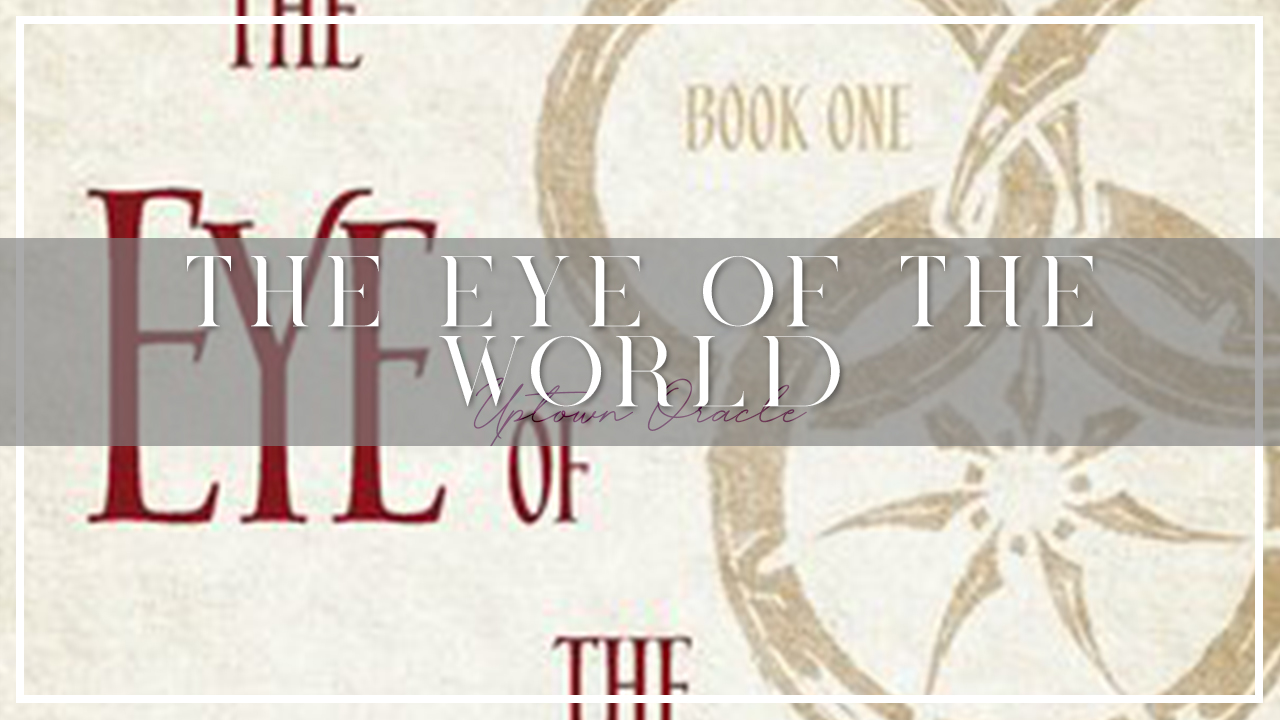
Few books define the phrase “epic fantasy” quite like The Eye of the World. As the first instalment in Robert Jordan’s The Wheel of Time series, it’s a sprawling, richly built adventure that draws heavily from Tolkien-esque roots while forging its own intricate mythos. It’s a book of immense scope and one that feels like stepping into an entire world rather than simply reading a story.
It’s not without its pacing quirks or dense prose, but it’s also the kind of fantasy that rewards patience with depth, detail, and a growing sense of awe.


(Affiliate Links)
The Wheel of Time turns and Ages come and pass, leaving memories that become legend. Legend fades to myth, and even myth is long forgotten when the Age that gave it birth returns again. What was, what will be, and what is, may yet fall under the Shadow.
Moiraine Damodred arrives in Emond’s Field on a quest to find the one prophesized to stand against The Dark One, a malicious entity sowing the seeds of chaos and destruction. When a vicious band of half-men, half beasts invade the village seeking their master’s enemy, Moiraine persuades Rand al’Thor and his friends to leave their home and enter a larger unimaginable world filled with dangers waiting in the shadows and in the light.
At the heart of this journey are Rand al’Thor, Mat Cauthon, Perrin Aybara, Egwene al’Vere, and Nynaeve al’Meara, ordinary youths thrust from their quiet village into a battle between Light and Shadow. Rand serves as our classic “chosen one” figure, and though his early portrayal can feel familiar, his arc is seeded with mystery and tension that pays off beautifully as the series unfolds.
Mat and Perrin balance him out, one mischievous and reckless, the other introspective and cautious, giving the trio a dynamic chemistry. The women of The Eye of the World, particularly Egwene and Nynaeve, are some of the most compelling in the series. Strong-willed, flawed, and capable, they provide a refreshing counterbalance to the boys’ often blundering heroics.
Moiraine and Lan, the enigmatic Aes Sedai and her stoic Warder, anchor the story with gravitas and a sense of destiny. Their mentorship transforms the story from a simple adventure into something mythic.
The book begins in the Two Rivers, a pastoral village suddenly attacked by monstrous Trollocs, setting off a journey that feels at once familiar and grand. The group flees under Moiraine’s guidance, embarking on a quest that takes them through ruined cities, dark forests, and ancient kingdoms.
The plot follows classic high-fantasy beats: a chosen one, an ancient evil, and a prophecy of salvation. But Jordan’s gift lies in the world-building. Every city, culture, and myth feels lived in, layered with history and meaning. The journey is long, yes at times, too long, but never dull for readers who relish immersion over speed.
The final act delivers a sense of scale and revelation fitting for the opener of such a vast saga, even if it leaves as many questions as it answers. Jordan’s prose is descriptive and deliberate. He paints in lush, often exhaustive detail. For some, this can feel heavy; for others, it’s the exact reason The Wheel of Time is so immersive.
Dialogue occasionally leans formal, and the early chapters echo Tolkien a little too closely, but as the narrative deepens, Jordan’s distinctive voice emerges: grand yet intimate, lyrical yet grounded in the emotional realism of his characters.
The Eye of the World grapples with destiny, courage, and the cyclical nature of good and evil, fittingly mirrored in the series title “Wheel of Time,” where ages repeat and heroes rise again. It’s about leaving home and facing a world far larger and darker than one imagined, but also about friendship, trust, and the burden of prophecy. There’s a timelessness to these themes that makes the story feel both mythic and human.
This is quintessential high fantasy with sprawling maps, ancient prophecies, magical orders, and a fully realised cosmology. Fans of The Lord of the Rings or The Stormlight Archive will find familiar comfort here, while readers of A Song of Ice and Fire may appreciate the political seeds that later grow into one of the genre’s most complex worlds. It’s a foundational text for fantasy readers that rewards commitment and curiosity.
Positives of The Eye of the World
- Exceptionally detailed world-building
- Strong ensemble cast with memorable dynamics
- Deep sense of myth and prophecy
- A satisfying blend of adventure, mystery, and destiny
Negatives of The Eye of the World
- Pacing drags in the middle section
- Heavy exposition and repetitive description
- Strong Tolkien influence early on
- Demands patience to fully appreciate
The Eye of the World is a dense yet rewarding read, a classic beginning to one of fantasy’s grandest series. While its pacing and prose can be demanding, the payoff is immense: a vast, living world and characters whose journeys echo long after the final page.
It may not be a book for everyone, but for those who love world-building, lore, and the slow unfurling of an epic tale, it’s an unforgettable gateway into something truly monumental.
If you enjoy content on Uptown Oracle consider supporting us:
Ko-fi | PayPal
The Eye of the World 🛞 Where Epic Fantasy Truly Begins | Uptown Oracle

Few books define the phrase “epic fantasy” quite like The Eye of the World. As the first instalment in Robert Jordan’s The Wheel of Time series, it’s a sprawling, richly built adventure that draws heavily from Tolkien-esque roots while forging its own intricate mythos. It’s a book of immense scope and one that feels like stepping into an entire world rather than simply reading a story.
URL: https://amzn.to/4pZsBoo
Author: Robert Jordan
4.5
