
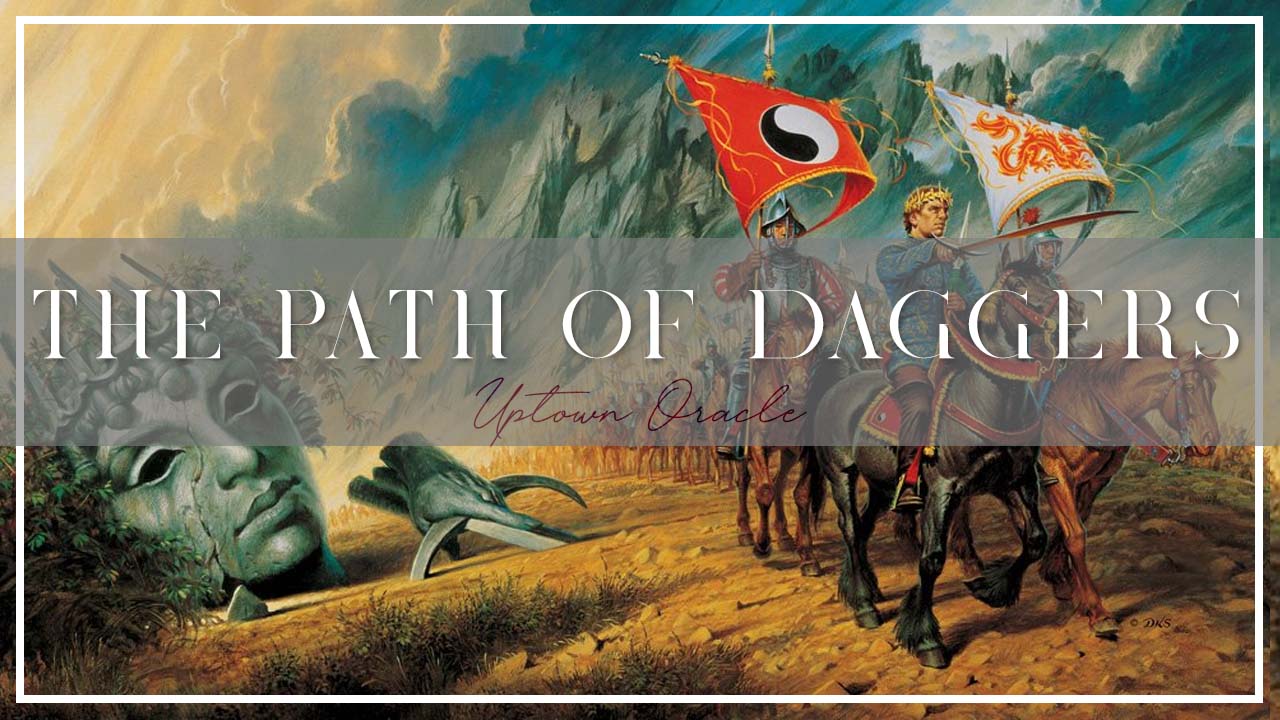
The Path of Daggers sits firmly in the part of The Wheel of Time where momentum slows, tensions rise, and consequences start piling up faster than victories. This is not a triumphant book. It’s anxious, fractured, and often frustrating for both our characters and us as readers. Jordan focuses more on the strain of leadership, the splintering of alliances, and the quiet realisation that winning doesn’t always look like winning. It’s an important instalment… even when it tests your patience.


(Affiliate Links)
Rand al’Thor engages in battle wearing the Crown of Swords and wielding Callandor against a force unprepared for the wrath of the Dragon Reborn.
The Seanchan invaders are heading for Illian―and Rand’s army of Asha’man soldiers. When they meet in battle, some of the Asha’man are afflicted by madness, unable to control their channeling and unleashing raw power.
The madness extends to Rand himself. He has been hearing the voice of a man believed to have been the previous Dragon Reborn. Besieged by visions and debilitated whenever he uses the One Power, Rand chooses to attack the Seanchan with Callandor. The sword consumes him with a berserker rage, felling ally and enemy alike. And when he regains his senses, Rand finds himself less trusted by those who were once the most loyal.
Rand is increasingly unravelling after being physically weakened, emotionally isolated, and driven by the need to act now, regardless of the cost. His decision-making in this book is impulsive and infuriating, but it feels earned. He’s operating under pain and paranoia, pushed by prophecy he doesn’t fully understand. This is one of the clearest portrayals yet of how being the Dragon Reborn is corrosive. Rand is no longer choosing between good and evil, but between bad options and worse ones.
Egwene continues her steady rise among the rebel Aes Sedai. While her arc here is quieter, it’s politically sharp whilst reading her play the long game while being underestimated remains endlessly satisfying. Nynaeve is still frustrating, still brilliant, and still stuck fighting herself as much as anyone else. Progress is there… just buried under several layers of temper.
Elayne’s succession storyline dominates much of the book, and while it makes sense politically, it’s one of the slower arcs. Necessary groundwork, but not the most gripping to read. Mat appears less than you’d hope, and Perrin’s absence continues to be felt. The cast feels slightly fragmented here thematically appropriate, but narratively uneven and it’s sometimes hard to stay interested in every POV.
Rand’s campaign against the Seanchan, should feel monumental. Instead, it’s chaotic, painful, and deeply uncomfortable. The battle doesn’t deliver a clean victory, and that’s the point. This is warfare without glory, and sets up worry for The Last Battle.
Around this, we see political manoeuvring, uneasy alliances, and characters scrambling to maintain control as the world shifts beneath them. The pacing is slow, and several plotlines feel like they’re treading water but the emotional weight steadily accumulates. This is very much a consequence book, not a payoff one.
Jordan’s prose remains detailed and deliberate, though here it often leans toward indulgence. Descriptions are rich, but sometimes linger too long, especially during political or military planning sequences. That said, when Jordan writes exhaustion, fear, and fractured authority, he’s excellent. The tone is oppressive not because of darkness alone, but because of relentless pressure.
The Path of Daggers is obsessed with cost. The cost of leadership, pride, and acting too soon – or too late. Rand’s arc, in particular, highlights how prophecy strips choice away, leaving duty and the cost of this in its place. There’s also a growing emphasis on division between nations, Towers, channelers, and even friendships are pulled apart under strain.
This entry leans hard into political and military epic fantasy. The mythic wonder of earlier books is still there, but buried beneath logistics, power struggles, and ideological conflict. Elayne goes to claim the throne she’s been raised to sit, whilst Perrin learns to wield power he’s never asked for.
Positives of The Path of Daggers
- Strong thematic focus on consequence and leadership
- Rand’s arc is painful but compelling
- Political tensions continue to deepen
- A refreshingly unglamorous portrayal of warfare
Negatives of The Path of Daggers
- Slow pacing and uneven focus
- Some arcs (Elayne’s especially) drag
- Reduced presence of fan-favourite characters
- Feels more like setup than story progression
The Path of Daggers is a difficult but necessary chapter in The Wheel of Time. It’s slower, heavier, and often frustrating but intentionally so. This is the cost-of-war book, the leadership-isn’t-glorious book, the “things are getting worse before they get better” book. Not a favourite, but one that earns its place in the pattern.
If you enjoy content on Uptown Oracle consider supporting us:
Ko-fi | PayPal
The Path of Daggers by Robert Jordan 🗡️ Power, Pride, and the Growing Cost of Being the Dragon | Uptown Oracle

The Path of Daggers sits firmly in the part of The Wheel of Time where momentum slows, tensions rise, and consequences start piling up faster than victories. This is not a triumphant book. It’s anxious, fractured, and often frustrating for both our characters and us as readers. Jordan focuses more on the strain of leadership, the splintering of alliances, and the quiet realisation that winning doesn’t always look like winning. It’s an important instalment… even when it tests your patience.
URL: https://amzn.to/498YLqQ
Author: Robert Jordan
3

Leave a Reply