
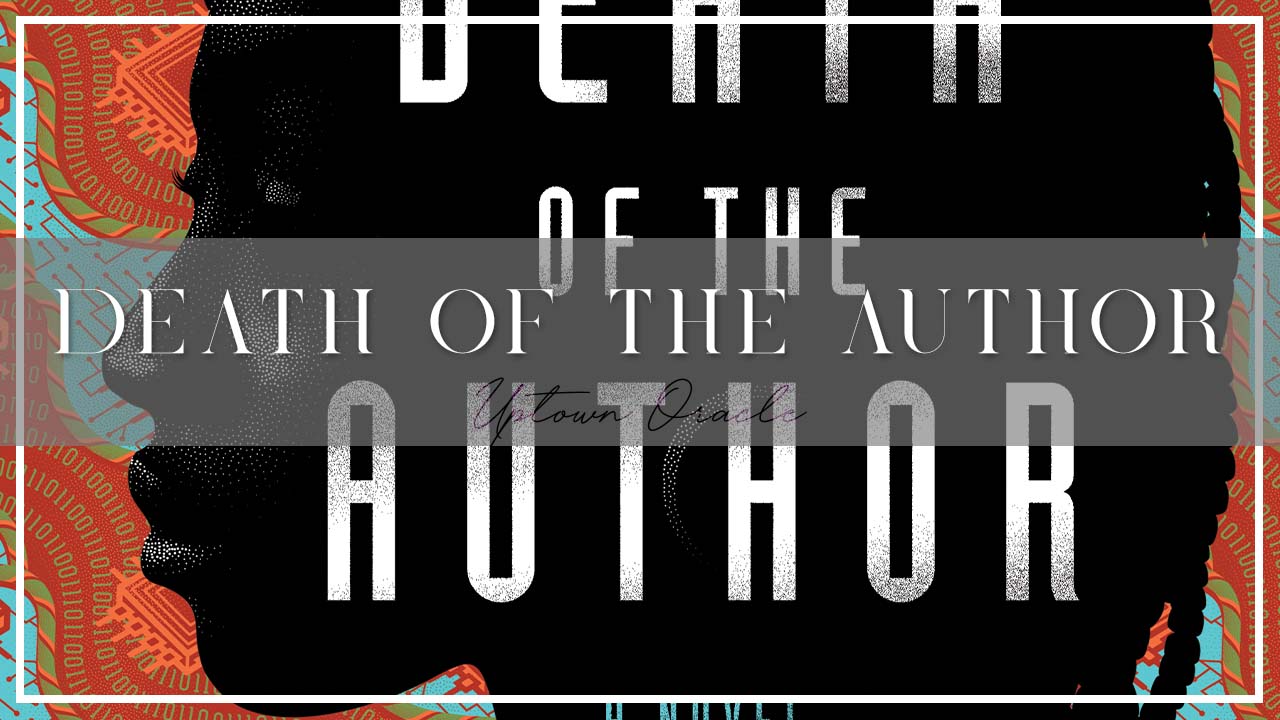
Death of the Author sets out to be bold with a multi-layered narrative exploring authorship, fame, identity, and the blurred lines between creator and creation. With a novel-within-a-novel structure and a protagonist navigating sudden literary success, it promises something sharp, introspective, and genre-bending.
What it delivers is certainly ambitious… but for me, it didn’t quite land.


(Affiliate Links)
Life has thrown Zelu some curveballs over the years, but when she’s suddenly dropped from her university job and her latest novel is rejected, all in the middle of her sister’s wedding, her life is upended. Disabled, unemployed and from a nosy, high-achieving, judgmental family, she’s not sure what comes next.
In her hotel room that night, she takes the risk that will define her life – she decides to write a book VERY unlike her others. A science fiction drama about androids and AI after the extinction of humanity. And everything changes.
What follows is a tale of love and loss, fame and infamy, of extraordinary events in one world, and another. And as Zelu’s life evolves, the lines between fiction and reality begin to blur.
Because sometimes a story really does have the power to reshape the world.
Zelu, our central protagonist, is a disabled author whose novel catapults her into fame. We follow her across three key stages: writing the book, experiencing its viral success, and navigating the aftermath.
The issue? She’s deeply unlikeable and not in a compelling, morally grey way. There’s a detachment to her character that makes it difficult to root for her, and frustratingly, that lack of connection extends across the entire cast.
Her family dynamics are steeped in toxicity, often distant, accusatory, and always unpleasant to read. While this clearly aims to explore generational trauma and pressure, it ends up feeling exhausting rather than insightful as you can’t root for any of them.
Her romantic relationship raises subtle red flags throughout, and her friendships, particularly with the doctor who claims he can “fix” her disability, feel surface-level and underdeveloped. I genuinely expected darker turns here that never came, leaving those relationships feeling hollow.
Ultimately, the characters across the board felt emotionally distant and, at times, unnecessarily harsh making it difficult to invest in their journeys and Zelu’s arc just wasn’t there. .
The novel is largely driven by family drama and personal conflict, rather than external stakes. Zelu’s rise to fame is positioned as monumental, her book is described as groundbreaking, universally adored, and culturally transformative.
However, the novel-within-the-novel sections, which should support that claim, didn’t reflect that level of impact. Instead, they felt difficult to engage with and, at times, actively pulled me out of the main narrative and bored me.
Structurally, this is a character-driven story… but without meaningful character growth. Events unfold one after another, yet there’s little sense of evolution, reflection, or consequence. It often feels like things are happening rather than building towards something.
The inclusion of Nigerian culture is a highlight, woven into the narrative in a way that feels authentic and informative without being overly didactic. The ending, however, felt rushed and unresolved lacking the emotional or thematic payoff the story seemed to be building towards.
One of the book’s selling points was its structure. The three distinct narrative styles
- the “main” story
- a series of interview transcripts
- the novel-within-the-novel
Where each have their own voice and rhythm. This layered approach is conceptually strong and would show some craft, but the sections don’t seem to compare/contrast against one another meaning you’re just code-switching throughout the book.
The pacing is undeniably slow. The narrative lingers, and without strong character engagement or plot momentum, it becomes difficult to stay invested. If I hadn’t been reading this alongside someone else, I’m not convinced I would have finished it.
At its core, Death of the Author aims to explore:
- authorship and ownership of stories
- fame and public perception
- identity and autonomy
- family trauma and expectation
These are rich, meaningful themes but the execution doesn’t always do them justice. There’s a sense the novel is reaching for something profound, but not quite managing to articulate it in a satisfying way.
Despite being marketed as Science Fiction, this is firmly literary fiction. The speculative aspects are confined largely to the novel-within-the-novel, and even there, they don’t dominate the reading experience.
If you’re going in expecting a sci-fi narrative, you’ll likely be disappointed. This is a slower, more introspective exploration of storytelling itself, and managing those expectations is key.
Death of the Author is an ambitious and structurally interesting novel that ultimately struggles to deliver on its ideas. With unengaging characters, slow pacing, and a lack of meaningful development, it becomes more frustrating than thought-provoking.
There are flashes of brilliance, particularly in its structure and cultural exploration, but they’re not enough to carry the weight of the whole.
Positives of Death of the Author
- Ambitious, layered narrative structure
- Distinct voices across multiple storytelling formats
- Strong inclusion of Nigerian culture and perspective
- Interesting concept around authorship and fame
Negatives of Death of the Author
- Unlikable and emotionally distant characters
- Slow pacing with limited payoff
- Weak engagement with the novel-within-the-novel
- Feels more literary than sci-fi (potentially misleading marketing)
- Rushed and unsatisfying ending
Death of the Author aims to say something meaningful about stories, identity, and the people who create them but for me, it felt more like an idea than a fully realised narrative.
A thought-provoking concept, but not one that fully comes together.
If you enjoy content on Uptown Oracle consider supporting us:
Ko-fi | PayPal
Death of the Author by Nnedi Okorafor 🤔 Ambitious, Layered, but Ultimately Frustrating | Uptown Oracle

Death of the Author sets out to be bold with a multi-layered narrative exploring authorship, fame, identity, and the blurred lines between creator and creation. With a novel-within-a-novel structure and a protagonist navigating sudden literary success, it promises something sharp, introspective, and genre-bending.
URL: https://amzn.to/3QQoVJu
Author: Nnedi Okorafor
2.5
