
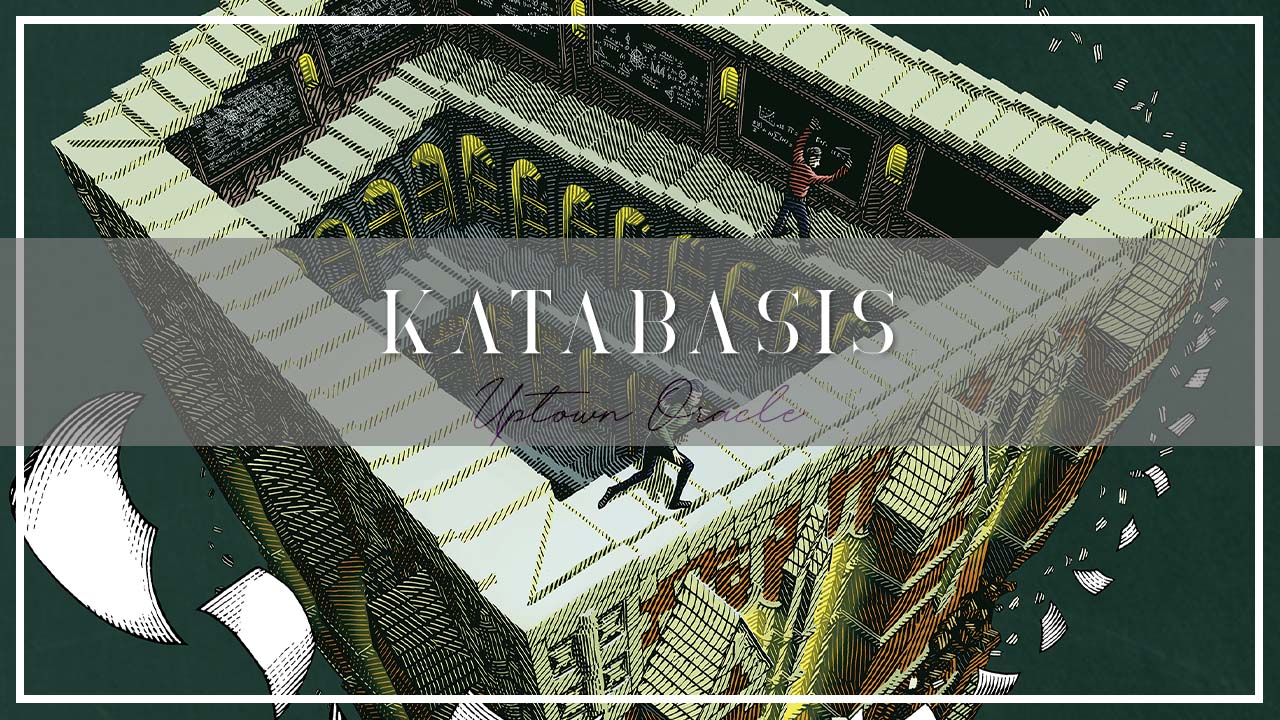
What happens when two Cambridge academics have to literally go to Hell to save their professor? In Katabasis, R.F. Kuang takes the obsessions of dark academia, intellectual ambition, toxic mentorship, rivalry, institutional power and the pursuit of knowledge at practically any cost, and builds an entire journey through the underworld around them.
Alice Law and Peter Murdoch are academic rivals, fellow advisees and two extremely intelligent people capable of debating philosophy, mathematics and magical theory while remaining spectacularly incapable of recognising some fairly obvious truths about themselves. When their professor Grimes dies, they descend into Hell to retrieve him, travelling through its eight courts while confronting the realities of their academic careers and the man they have sacrificed so much to impress.
Despite the amount of discussion online suggesting readers need to prepare with Dante’s Inferno, philosophy texts and various mythological sources before opening Katabasis, I don’t think that’s necessary. Kuang brings those ideas directly into the novel, allowing Alice and Peter’s debates to explain the philosophical and literary influences without requiring a pre-reading syllabus.


(Affiliate Links)
Katabasis, noun, Ancient Greek: The story of a hero’s descent to the underworld.
Alice Law has only ever had one goal: to become one of the brightest minds in the field of Magick. She has sacrificed everything to make that a reality: her pride, her health, her love life, and most definitely her sanity. All to work with Professor Jacob Grimes at Cambridge, the greatest magician in the world.
That is, until he dies in a magical accident that could possibly be her fault.
Grimes is now in Hell, and she’s going in after him. Because his recommendation could hold her very future in his now incorporeal hands and even death is not going to stop the pursuit of her dreams….
Nor will the fact that her rival, Peter Murdoch, has come to the very same conclusion.
With nothing but the tales of Orpheus and Dante to guide them, enough chalk to draw the Pentagrams necessary for their spells, and the burning desire to make all the academic trauma mean anything, they set off across Hell to save a man they don’t even like.
But Hell is not like the storybooks say, Magick isn’t always the answer, and there’s something in Alice and Peter’s past that could forge them into the perfect allies…or lead to their doom.
Alice is an academic before almost anything else. As one of the first women admitted into Cambridge’s intensely male academic environment, she is determined that nobody should be able to dismiss her achievements as the result of anything other than her own intelligence and work.
She specifically rejects the feminism of many women around her, believing that success should come from proving herself within the existing system rather than challenging it. That determination has also shaped her decision to study under Grimes. His reputation can open doors, and Alice is willing to tolerate an extraordinary amount to ensure those doors open for her.
That makes her relationship with academia fascinatingly complicated. Alice knows the system is stacked against her but she simply believes she can beat it. Her intelligence doesn’t protect her from manipulation, however. Much of her character arc involves recognising how thoroughly Grimes has shaped her ambitions, relationships and perception of herself.
Peter is Alice’s academic rival and Grimes’s other advisee. Where Alice’s strengths lie in language, Peter approaches magic through mathematics. Their different disciplines create some of the novel’s most interesting conversations as they attempt to solve the rules governing Hell. They are competitive, stubborn and both convinced that they understand the other person considerably better than they understand themselves.
Peter also provides an important parallel to Alice. Grimes’s toxic mentorship affected them differently, but both have allowed their academic ambitions to shape almost every part of their lives. The fact that two people this intelligent can be quite so oblivious about their feelings for one another is both frustrating and entirely believable given the environment Grimes created around them.
Grimes is the reason the entire journey happens. He’s also arguably the villain of Alice and Peter’s lives. A prestigious academic obsessed with his own work and reputation, Grimes has cultivated generations of students while treating them largely as extensions of his intellectual legacy.
As Alice and Peter travel deeper into Hell, the novel gradually exposes just how much damage his mentorship has caused. His students have sacrificed relationships, happiness and even themselves in pursuit of the approval and opportunities he controls. Even after death, Grimes continues to exert influence over them. The obvious question becomes less can they save him? and more why are they even trying?
Elspeth is one of the supporting characters who deserves particular attention. A former advisee of Grimes who died by suicide, she has managed to construct a new existence for herself in death, travelling along the Lethe and helping Alice and Peter during their journey.
Her ability to transform into butterflies provides some beautiful symbolism. While her mortal life became defined by Grimes and academic suffering, death allows her to undergo a continued transformation into someone existing entirely on her own terms. Elspeth’s storyline also provides another perspective on the consequences of Grimes’s mentorship, showing Alice a possible version of where the same pursuit of academic validation can lead.
The Kripkes are among the primary antagonists within Hell, a family of magicians attempting to return to the mortal world. Travelling through the courts as a couple with their son, they kill living visitors to obtain the blood required to continue practising magic. Their presence adds a more conventional threat to Alice and Peter’s journey, while also reinforcing the idea that everyone they meet in Hell has their own reasons for wanting to escape it.
Archimedes is the Cambridge cat and, naturally, one of the book’s best additions. While humans are largely confined to either the mortal world or Hell, animals appear capable of moving between the two much more freely. Archimedes therefore becomes both helper and companion to Alice throughout the story. Sometimes he actively assists her; at other points, he simply provides a familiar face within an increasingly strange and isolating world.
Hell is substantially more manageable when there is a cat.
Katabasis is exactly what its title promises: a descent into the underworld. Both Alice and Peter intend to enter Hell, locate Grimes and bring him back. Their journey takes them through eight courts of Hell, many associated with familiar sins and philosophical concepts. Kuang transforms Hell into something that often resembles an enormous academic institution.
There are libraries. Research. Rules requiring interpretation. Scholars who have spent their afterlives working on intellectual problems. Even the supernatural frequently becomes something to be debated, theorised about and footnoted. It makes perfect sense for this particular cast of characters.
Alongside the journey through Hell, the novel regularly returns to Alice and Peter’s lives at Cambridge. These flashbacks gradually explain why two otherwise rational people are willing to walk through the underworld for a professor who treated them terribly. The two timelines work particularly well together. Each new revelation from their academic lives changes how we understand their current mission.
There is also a romance at the centre of Katabasis, but I definitely wouldn’t describe this as romantasy. The relationship develops alongside the main plot rather than driving it, and there is no spice. The fantasy, philosophy and dark academic elements remain considerably more important than the romance.
Kuang manages to make a novel built around philosophy, mathematics, literary references and academic debate surprisingly accessible. There are clear influences from works such as Dante’s Inferno alongside wider mythological and philosophical traditions, but the novel doesn’t require readers to arrive with extensive background knowledge.
Instead, Alice and Peter frequently debate the ideas themselves. Because they’re academics from different disciplines, these discussions feel natural within their relationship while simultaneously giving the reader enough information to understand the concepts being explored.
The magic also works particularly well within Kuang’s academic framework. Paradoxes and arguments aren’t simply intellectual exercises, they can actively shape reality. Convincing someone that something is true can become more important than whether it objectively is true. That connection between rhetoric, belief and magic becomes particularly effective when placed alongside the novel’s broader interest in self-delusion.
Magic itself in Katabasis is closely tied to reasoning. Rather than simply casting spells, characters manipulate reality through paradoxes, logic, mathematics and belief. Different academic disciplines therefore provide different approaches to the magical system.
Alice’s linguistic background and Peter’s mathematical expertise complement one another particularly well. They can reach similar magical outcomes through very different ways of thinking. The system also reinforces one of the novel’s central ideas: reality and perception don’t always perfectly align.
Sometimes making someone believe your argument matters more than proving yourself objectively correct. Which, incidentally, feels extremely appropriate for a novel about academia. An overall impressive magic system that feels well thought out.
At the centre of Katabasis lies a brutal examination of academic ambition. Alice and Peter are both highly intelligent, talented people who have nevertheless allowed their desire for recognition to trap them within Grimes’s toxic orbit. Their journey asks how much someone should sacrifice for academic success and at what point ambition stops being admirable and becomes self-destruction.
There’s themes around power and toxic mentorship. Grimes possesses power over his students because academic careers depend on reputation, recommendations and access. Alice knows he can open doors for her. That knowledge makes it much harder to challenge his behaviour. The novel examines how abusive systems can persist not because nobody recognises the problem, but because the people experiencing it have been convinced that enduring it is necessary for success.
Self-delusion appears repeatedly throughout the novel. Characters believe things about themselves, their relationships and their motivations that are not necessarily true. This works particularly well alongside the magic system, where paradoxes and belief can alter reality. The novel continually asks whether believing something strongly enough can make it true and what happens when reality eventually refuses to cooperate.
The journey through Hell naturally raises questions about whether events are predetermined and fate. Characters encounter systems that attempt to categorise people according to their lives and actions, while Alice and Peter repeatedly have to decide whether they are following paths chosen for them or making genuine choices of their own.
Katabasis is dark academia fantasy in perhaps the most literal possible sense. The Cambridge setting, intense academic rivalry, intellectual discussions, toxic mentorship and obsession with knowledge contain practically every hallmark of dark academia, while the underworld journey pushes those ideas firmly into fantasy.
I’d also recommend it to readers who enjoy lower fantasy settings where the fantastical exists alongside a recognisable real world. Despite the romantic subplot, this isn’t romantasy. Readers coming primarily for the relationship may find the academic and philosophical material dominates more of the story.
The journey through the eight courts is imaginative, the magic system cleverly reflects the characters’ academic disciplines, and Alice and Peter make compelling leads precisely because they’re so intelligent in some ways and spectacularly blind in others. Most importantly, I never felt the background reading some discussions around the novel suggested would be essential. Kuang gives readers enough context to understand the influences behind Hell while still leaving plenty for those already familiar with Dante, mythology and philosophy to recognise. It’s intelligent without requiring the reader to prove they’re intelligent enough to read it.
Positives of Katabasis
- Fantastic dark academia setting and themes
- Alice and Peter make equally compelling leads
- Clever magic system built around paradoxes and academic disciplines
- Accessible use of philosophy, mythology and Dante’s Inferno
- Strong critique of toxic academic mentorship
- Elspeth is an excellent supporting character
- Interesting interpretation of Hell as an academic environment
- Archimedes the cat, obviously
- Romance remains secondary to the fantasy plot
Negatives of Katabasis
- Academic and philosophical discussions may be dense for some readers
- The journey through multiple courts can occasionally feel structurally repetitive
- Readers expecting romantasy may be disappointed by how secondary the romance is
- Grimes is so spectacularly awful that occasionally you do wonder why anyone is still walking through Hell for him
So, is Katabasis worth reading if you’re looking for dark academia fantasy? Absolutely.
R.F. Kuang takes academic ambition, intellectual rivalry and toxic mentorship and turns them into an actual descent through Hell, creating a novel where the fantastical elements reinforce rather than simply decorate its ideas.
Beneath all the mathematics, philosophy and magical paradoxes, however, Katabasis is ultimately about two people learning to recognise how thoroughly someone else has shaped their understanding of success, themselves and each other. They may be trying to bring their professor back from the dead, but the far more interesting journey is discovering whether they actually want the lives he taught them to pursue.
If you enjoy content on Uptown Oracle consider supporting us:
Ko-fi | PayPal
Katabasis by R.F. Kuang Review 📚 Is This Dark Academia Fantasy Worth Reading? | Uptown Oracle

What happens when two Cambridge academics have to literally go to Hell to save their professor? In Katabasis, R.F. Kuang takes the obsessions of dark academia, intellectual ambition, toxic mentorship, rivalry, institutional power and the pursuit of knowledge at practically any cost, and builds an entire journey through the underworld around them.
URL: https://link.amazon/B0591XgLe
Author: R.F. Kuang
4.5

Leave a Reply