
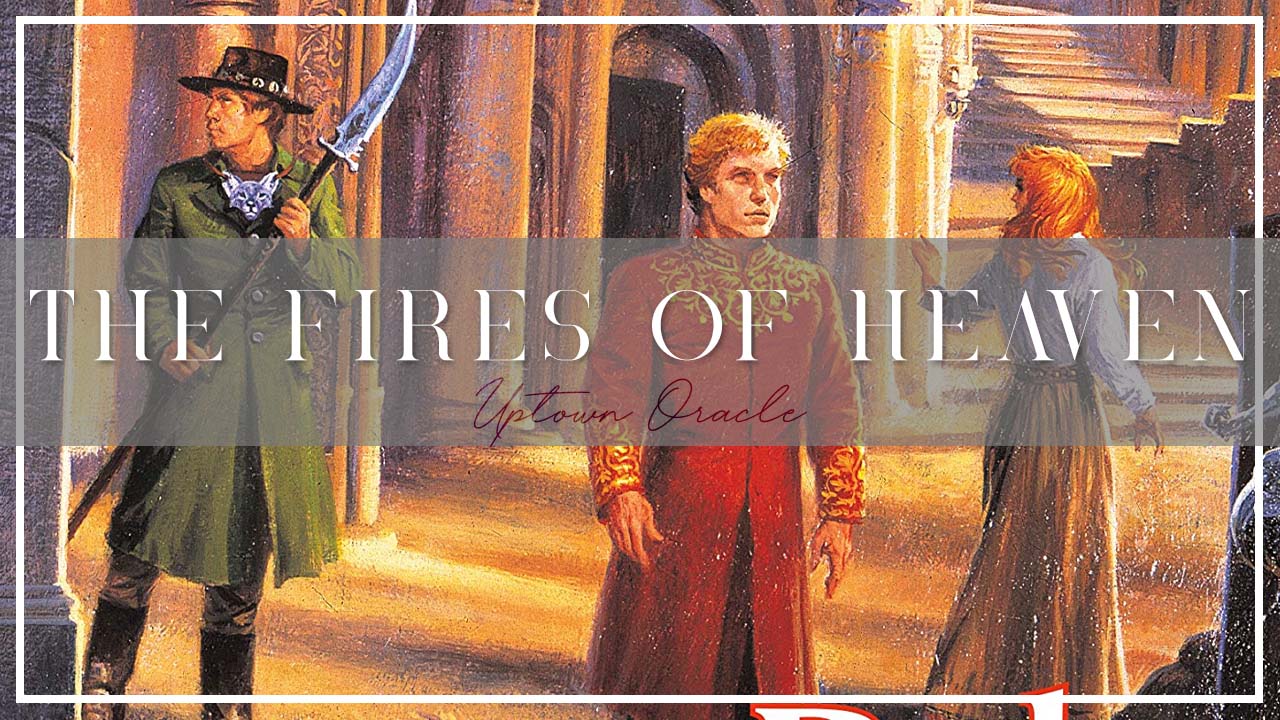
By the time The Fires of Heaven rolls around, The Wheel of Time has well and truly hit its stride. We’re past the early wanderings and deep into the political and personal turmoil of being the Dragon Reborn. This fifth instalment sees Rand grappling with leadership, prophecy, and the crushing weight of destiny while the women of the series find themselves scattered across continents, chasing enemies, and occasionally, each other’s patience.
It’s a hefty book, filled with triumphs, tension, and the occasional bout of narrative meandering. While it has some truly jaw-dropping moments, it also feels like one of the more transitional volumes of the saga rather than a core turning point.


(Affiliate Links)
In The Fires of Heaven, the fifth novel in Robert Jordan’s #1 New York Times bestselling epic fantasy series, The Wheel of Time, four of the most powerful Forsaken band together against the Champion of Light, Rand al’Thor.
Prophesized to defeat the Dark One, Rand al’Thor, the Dragon Reborn, has upset the balance of power across the land. Shaido Aiel are on the march, ravaging everything in their path. The White Tower’s Amyrlin has been deposed, turning the Aes Sedai against one another. The forbidden city of Rhuidean is overrun by Shadowspawn.
Despite the chaos swirling around him, Rand continues to learn how to harness his abilities, determined to wield the One Power–and ignoring the counsel of Moiraine Damodred at great cost.
This is a Nynaeve-heavy book, and honestly, it’s about time she got her spotlight. She’s still the same stubborn, sharp-tongued force we know, but we finally see cracks in her armour with moments of humility, humour, and genuine growth. Her feelings for Lan surface more openly, adding emotional depth that makes her chapters more rewarding (even if her temper remains intact).
Rand, on the other hand, hardens. His arc here is steeped in power, paranoia, and politics. No longer content to be led by Moiraine or anyone else, he begins to command and sometimes dictate his destiny. Watching him wrestle with what it means to be the Dragon Reborn is both fascinating and unsettling. The once sheepherder is slipping away, replaced by something colder, steelier, and far more dangerous.
Moiraine herself mellows in a way that’s both surprising and satisfying. Her mentorship of Rand evolves from control to trust, culminating in a finale that’s nothing short of shocking. It’s one of Jordan’s boldest moves and one that reshapes the balance of the entire series.
Meanwhile, Nynaeve and Elayne’s side plot provides levity (and the occasional headache). Their constant power struggle is funny at first, but after the fifth argument over who’s in charge, I found myself craving a change in POV.
Mat continues to be one of the series’ most consistently entertaining POVs, snarky, reluctant, and yet always landing in the thick of things. His first major battle sequence is fantastic, showing him stepping into leadership in his own chaotic way. And yes, I missed Perrin. His absence leaves a noticeable gap.
Siuan and Leane’s subplot post-stilling adds a refreshing human note to the book, showing resilience and the quiet determination to keep fighting despite losing everything. Morgase’s chapters, however, drag. The Andor politics are a useful context, but I’d have preferred to see that through Elayne, Galad, or Gawyn’s eyes.
The Fires of Heaven sprawls with travel, tension, and a fair bit of filler. Rand’s march through Cairhien and beyond gives us grand, sweeping politics and the sense of a man learning to command armies as easily as he commands the One Power.
Meanwhile, Nynaeve and Elayne’s “circus arc” is a divisive part of the book. It’s slow, whimsical in places, and at times feels disconnected from the main conflict. Still, it’s balanced by the riveting Tower and Forsaken storylines, which provide momentum.
The pacing overall is slow, with the final act hitting hard after a meandering build-up. But those final chapters, the twists, betrayals, and shocking losses, are some of Jordan’s most unforgettable work so far. This instalment expands The Wheel of Time’s world dramatically. As the characters travel, we see new lands, cultures, and hierarchies that further deepen Jordan’s already colossal setting.
The Forsaken finally feel present, whilst manipulative, dangerous, and unpredictable. Their influence gives this book a creeping sense of dread that balances the slower political chapters. Meanwhile, the Tower’s fractured politics are some of the best in the series, full of shifting loyalties and sharp power plays. It’s not the flashiest world-building book, but it’s certainly one that deepens the complexity of the game being played.
The One Power scenes feel tighter and more purposeful here. Rand’s control continues to grow, reflecting both his strength and volatility. Tel’aran’rhiod, the World of Dreams, takes on more prominence and I’m keen to see how it develops in later books. Elayne using the One Power as part of a circus act? Brilliantly absurd, and a rare moment of levity in an otherwise heavy book. The Forsaken’s manipulations in both the waking and dream worlds are some of the most chilling uses of magic Jordan’s written yet.
The Fires of Heaven is a study in power and how it corrupts, isolates, and demands sacrifice. Rand’s growing detachment from those around him mirrors the cost of leadership, while Nynaeve and Elayne’s conflict explores control in a smaller, more personal way.
Trust and betrayal weave through every thread: among the Aes Sedai, the Forsaken, and even the companions themselves. Prophecy continues to hang over everything, an unrelenting reminder that destiny is both a blessing and a curse.
Jordan’s prose remains lush and layered, though this book edges toward indulgence. The pace often slows under the weight of detail, and while his eye for setting remains unmatched, it occasionally smothers momentum.
Tonally, this entry feels darker and heavier than its predecessors. There are moments of humour (mostly from Mat!) but the overall tone leans grim, as war, loss, and responsibility start to take their toll on the characters.
Compared to earlier volumes, The Fires of Heaven feels more political fantasy than adventure. The magic remains, but it’s increasingly woven into court intrigue and military manoeuvring. It’s less about discovery now, and more about survival of nations, loyalties, and identities.
It’s not the most memorable or fast-paced book in the series, but it’s an essential bridge. You can feel Jordan laying groundwork for massive payoffs still to come.
Positives of The Fires of Heaven
- Fantastic development for Nynaeve, Rand, and Mat
- Strong political intrigue and Forsaken plotting
- A jaw-dropping, emotional ending
- Expands the world and raises the stakes
Negatives of The Fires of Heaven
- Pacing issues and filler subplots (circus arc, Morgase scenes)
- Overlong travel sequences
- Missing Perrin left a gap
- Could have been more concise without losing impact
The Fires of Heaven is a slower, more introspective chapter of The Wheel of Time. Filled with growth, grit, and a few too many side quests. While it doesn’t quite reach the high peaks of The Shadow Rising, it delivers critical character development and one of the most shocking endings so far. A necessary bridge in the saga, if not a standout one but even Jordan’s quieter books still hum with the heartbeat of a world few authors could build.
If you enjoy content on Uptown Oracle consider supporting us:
Ko-fi | PayPal
The Fires of Heaven by Robert Jordan 🔥 A Transitional Chapter of Power, Pride, and Prophecy | Uptown Oracle

By the time The Fires of Heaven rolls around, The Wheel of Time has well and truly hit its stride. We’re past the early wanderings and deep into the political and personal turmoil of being the Dragon Reborn. This fifth instalment sees Rand grappling with leadership, prophecy, and the crushing weight of destiny while the women of the series find themselves scattered across continents, chasing enemies, and occasionally, each other’s patience.
URL: https://amzn.to/3MxIYuc
Author: Robert Jordan
4

Leave a Reply