
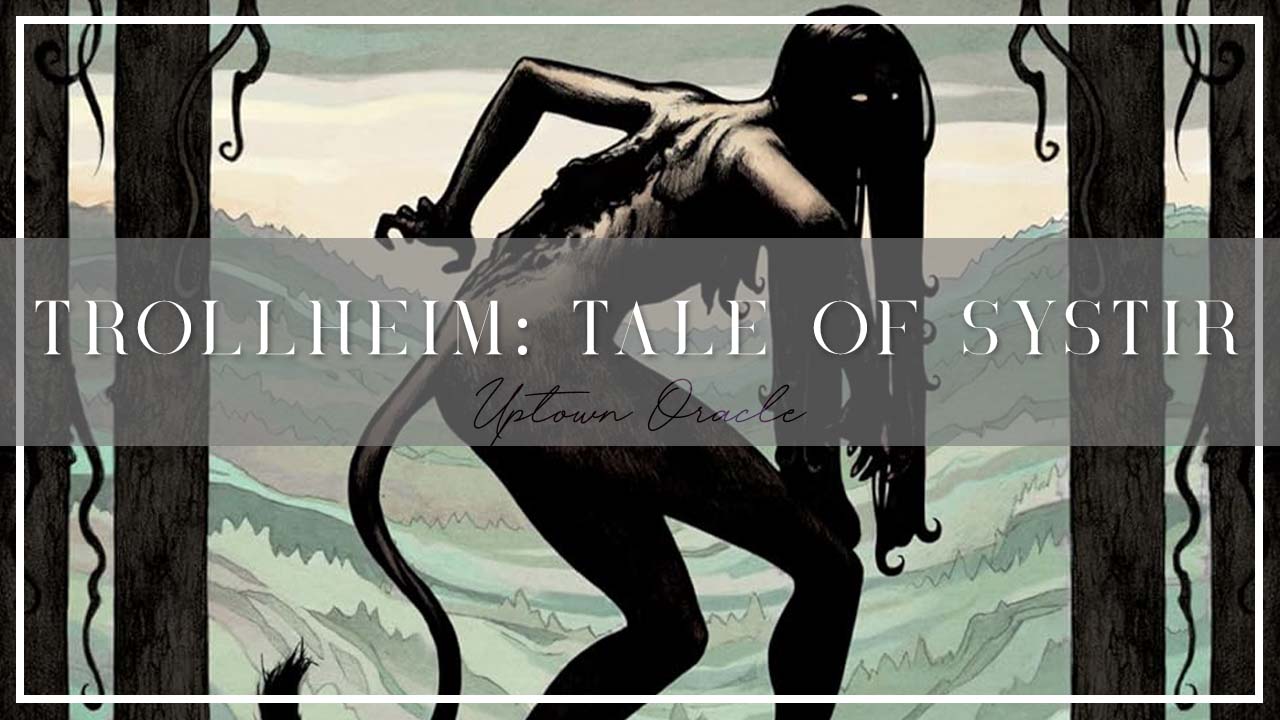
Dark forests, trolls, huldurs, vasen and grief, Trollheim: Tale of Systir by Georgia Summers has all the ingredients of a strange folkloric fantasy. At the centre of it is Systir, a girl forced to flee everything she knows after her mother is accused of witchcraft. Separated from her sister and swallowed by the Dark Forest, Systir’s story becomes less about escaping danger and more about discovering what she is, where she belongs, and whether the family we choose can become just as important as the family we lose.
This is a deeply character-focused novel, more interested in identity, grief and belonging than in rushing towards a conventional fantasy quest. That gives the book plenty of emotional depth, but it also results in some unusual pacing and a plot that takes a while to reveal where it is actually going.


(Affiliate Links)
Sýstir’s world is small and quiet, but shrouded in secrets. Outside of her family’s cottage lurks the constant threat of being discovered for what she truly unwanted, dangerous, Huldra. When their mother is accused of witchcraft and dragged to the stake, she and her sister must run for their lives. Yet only Sýstir escapes.
Taken in by the rogue troll Agagkantor, Sýstir finds herself in the Dark Forest, otherwise known as Trollheim. Here, she discovers a magical realm for mythical beings and a sanctuary for those with nowhere left to turn. For Sýstir, it’s a chance to forge a new family and live life as her true self. But questions remain about her missing sister, and Agagkantor carries a secret of his own – one that could unravel Sýstir’s past and destroy the Dark Forest entirely…
Systir begins the novel as a frightened child running from one of the most traumatic events imaginable. Her mother is being burned as a witch, her village has become dangerous, and she is forced to flee alongside her sister Ada. When the two become separated, Systir enters the Dark Forest alone and the life she knew effectively ends.
What follows is not a traditional coming-of-age story but more a transformation. As Systir grows within the forest, she becomes increasingly connected to it and eventually develops more into her huldra side than the human half she’d grown up as. Her changing identity is central to the novel, particularly because she begins life as someone who has already been rejected by human society.
The question isn’t simply whether Systir is human, vasen, or huldra. It’s whether any one label actually defines who she is. Her emotional journey is strongest when the novel explores how loss has shaped her and how desperately she wants somewhere to belong.
Agagkantor is the troll who finds Systir and takes her in. Living separately from the Rise because of his own past, he becomes Systir’s adoptive parent and provides her with the first sense of safety she has experienced since fleeing her village. Their relationship forms much of the emotional foundation of the book. Agagkantor is not simply the wise guardian trope though. His own history with troll society creates tension around the wider conflict and gives Systir another example of someone who has chosen to live outside the structures that were supposed to define him. His care for Systir becomes one of the clearest examples of the book’s exploration of found family.
Fungir is one of the trolls Systir comes to befriend, helping connect her with the wider community beyond Agagkantor. Their friendship becomes important as Systir begins navigating troll society and understanding the tensions within the Rise. Fungir also allows Systir to develop relationships that aren’t entirely parental, giving her someone closer to a peer within a world she is still learning to understand.
Queen Hilda leads the trolls and the Rise. Her presence introduces the political and societal side of troll life, widening the novel beyond the smaller world Systir shares with Agagkantor. Through Hilda and the Rise, the book begins examining how troll society functions and where Systir may or may not fit within it.
Fenrir is a lynx cub Systir takes in and cares for. In a story filled with loss, transformation and conflict, Fenrir provides a softer emotional thread. Systir’s relationship with him also reinforces her connection to the natural world and the instinctive compassion she shows towards creatures around her. And frankly, a fantasy book is almost always improved by the addition of a loyal animal companion.
Trollheim: Tale of Systir is much more character-driven than plot-driven. There is a central narrative running through the book, but for roughly the first half, the story is primarily focused on Systir entering the Dark Forest, adapting to life with Agagkantor and gradually learning about what she is.
Because of this, it can initially be difficult to understand what the larger plot actually is. Rather than presenting an immediate quest or clear antagonist, Summers allows the story to unfold slowly through Systir’s experiences. We learn about troll society, the Rise, the Dark Forest and the strange forces shaping its inhabitants at roughly the same pace she does.
Once the wider conflict becomes clearer, the pacing begins to pick up and the earlier character work starts connecting to the larger narrative. The story ultimately becomes concerned with far more than Systir’s survival. Questions surrounding vengeance, justice, belonging and the damage caused by unresolved grief begin shaping her choices. This slow reveal works thematically, but it does mean readers looking for immediate momentum may struggle during the first half.
Georgia Summers writes with a distinctly folkloric atmosphere. The Dark Forest feels old, dangerous and alive, filled with creatures and traditions that exist according to their own logic rather than familiar modern fantasy rules. The writing works best when describing Systir’s relationship with the landscape and her gradual transformation within it.
However, the pacing can feel inconsistent. Some sections are deliberately slow and introspective, focusing on Systir’s relationships and inner life. Others suddenly accelerate as the wider plot comes into focus. The shift is occasionally jarring, particularly because the early chapters spend so much time establishing character and setting before revealing the larger direction of the story. The quieter storytelling suits the book’s emphasis on identity and grief.
Identity is perhaps the strongest theme running through Trollheim. Systir begins as a human girl hiding her huldra side, becomes part of a troll household and gradually transforms into a huldra trying to remove her human side. Yet none of those identities completely defines her. The novel explores how identity can be shaped by both nature and experience, while questioning whether belonging requires choosing one world over another.
Family appears in several different forms. Systir begins with the devastating loss of her biological family but eventually finds something entirely different with Agagkantor and the people of the forest. The novel strongly embraces the idea that family can be created through love, care and loyalty rather than blood alone.
Grief and loss shapes almost every major character. Systir’s journey begins with grief, while other characters carry their own histories of pain and separation. Rather than treating grief as something people simply overcome, Summers presents it as something that changes shape over time.
One of the most interesting thematic ideas in the novel is Rotinn. Rotinn functions as a metaphor for depression: something that takes root, spreads and begins changing the person carrying it. Rather than presenting sadness as temporary or easily solved, the metaphor captures how depression can become consuming, altering how someone perceives both themselves and the world around them. It adds an emotional layer to the fantasy elements.
Systir has every reason to be angry. Her childhood is destroyed by violence and prejudice, and much of her journey involves deciding what should be done with that anger. The novel repeatedly questions the difference between justice and vengeance, particularly when harm has already been done and cannot simply be undone.
Trollheim: Tale of Systir sits firmly within fantasy, with particularly strong influences from folklore and mythology. Rather than relying on an intricate hard magic system, the novel embraces the stranger logic of traditional tales. Trolls, huldras and supernatural forests exist alongside themes that feel much more grounded and contemporary.
Readers who enjoy atmospheric, character-focused fantasy will probably get the most from this. Those looking for a fast-paced quest or constant action may find the first half slower than expected.
Trollheim: Tale of Systir is an emotionally thoughtful fantasy that works best as a character study. Systir’s journey from frightened child to someone increasingly shaped by the Dark Forest is compelling, while her relationships with Agagkantor, Fungir and Fenrir give the story plenty of warmth beneath its darker exterior.
The themes of identity, grief, family and depression are handled particularly well, especially through the metaphor of Rotinn. However, the plot takes a long time to fully reveal itself, and the pacing can feel uneven as a result. For much of the first half, I was more invested in Systir’s personal journey than in understanding where the overall story was going. Once those elements begin coming together, though, the novel becomes considerably stronger.
Positives of Trollheim: Tale of Systir
- Strong and sympathetic central character
- Beautiful found-family relationship between Systir and Agagkantor
- Atmospheric folkloric world-building
- Thoughtful exploration of identity and belonging
- Rotinn works well as a metaphor for depression
- Interesting themes of vengeance versus justice
- Fenrir is an excellent animal companion
Negatives of Trollheim: Tale of Systir
- The wider plot takes a long time to become clear
- Uneven pacing throughout
- The first half can feel more like extended setup
- Some supporting characters could use further development
- Readers wanting action-heavy fantasy may find it too slow
Trollheim: Tale of Systir is at its strongest when it stops worrying about where Systir is going and focuses on who she is becoming. Georgia Summers uses trolls, huldras and dark forests to explore very human questions about grief, identity, depression and the families we build after losing the ones we began with.
The pacing isn’t always smooth and the central plot takes its time emerging, but Systir’s emotional journey gives the novel a strong foundation. A strange, melancholic and thoughtful folkloric fantasy about finding a home in the places you never expected to belong.
I received Trollheim: Tale of Systir by Georgia Summers from the publisher. This is an unbiased and honest review
If you enjoy content on Uptown Oracle consider supporting us:
Ko-fi | PayPal
Trollheim: Tale of Systir by Georgia Summers Review 📚 A Dark Folkloric Fantasy About Identity, Grief and Found Family | Uptown Oracle

Dark forests, trolls, huldurs, vasen and grief, Trollheim: Tale of Systir by Georgia Summers has all the ingredients of a strange folkloric fantasy. At the centre of it is Systir, a girl forced to flee everything she knows after her mother is accused of witchcraft. Separated from her sister and swallowed by the Dark Forest, Systir’s story becomes less about escaping danger and more about discovering what she is, where she belongs, and whether the family we choose can become just as important as the family we lose.
URL: https://link.amazon/B0j8zJq0h
Author: Georgia Summers
3.5

Leave a Reply